During the last year, I have wanted to write about multitude of changes that are happening and are going to happen in the PC industry. Topics that I would have liked to discuss were the upcoming Windows 8, emergence of endless stream of Android tablets, wireless technologies, mobile optimized chips from Intel and AMD, etc.. However I had a writers block, I couldn't write about these topics because I had not made my mind on what the bigger picture was. Now I know. The bigger picture is that we are at the end of the road for home computer, and that is a major cause of change in the computer industry.
Why is it happening? There is basically two reasons for it, one being driven by technological development, and the second on being changing usage patterns of people. In the past home computers were used as productive tools, then as a way to access information and the Internet, and now they are used mainly for consuming media and engaging entertainment. Home computers, be it desktops or laptops, can fulfill these needs, but not optimally, and certainly not with ease of usage. Instead of a home computer, a better way to fulfill these needs is to use range of different devices like gaming consoles, Internet enabled TVs and tablets linked to each other and other peripherals via wireless connection.
One might ask why is the change coming now and not before, the reason is that technology is becoming ready, it is powerful enough and more importantly easy enough to use. For example you can stream music from your phone or tablet to your stereo system; you can print to wireless printer; etc... In short, your devices are talking to each other, thus you don't need one uber device to do everything.
When will it happen? This is a tricky question to answer, but essentially it is all about consumer perceptions on what is needed to fulfill their needs. The day when your average Joe says to himself that instead of getting a new computer to use Facebook and YouTube, he will instead buy a new tablet with a wireless keyboard and printer if needed. This change can happen very rapidly, maybe even a time frame of just few years. However to speak frankly, we are not there yet. The technology isn't powerful enough, when we have for example AMD Fusion or upcoming Intel Ivy Bridge processors with 4 gigabytes of memory packed inside a tablet or other media device, then the technology will be ready. This would more or less put the time frame from end of 2012 to 2014.
What does it mean? End of Windows monopoly in the home market if Microsoft doesn't successfully retake markets from Apple and Google Android with Windows 8. End of open access and free usability of various devices for the majority of users, in short everything will be locked, users download their software and content from their designated shops or use Internet delivered applications and services to fulfill their needs.
From a point of view of a professional working in the software industry, this upcoming change will create both opportunities to be taken and dangers that need to be counteracted. One pit fall that I see is that companies will be spending too much time and money on tailoring applications for different platforms, a dangerous trend that we are already seeing with smart phones. Instead companies should use this opportunity to get rid of all native applications and technologies, moving to pure web based technologies that can be offered to all platforms. It may not be optimal, but cost effective flexibility is something that will be needed in the coming years.
Showing posts with label software. Show all posts
Showing posts with label software. Show all posts
Monday, 2 January 2012


Saturday, 10 December 2011
Creating business around of the next billion
One of the strategic goals of Nokia is to bring out mobile phones and devices to the next billion people in the developing world, namely in Africa, India and Asia Pacific. To this day reaching out this goal has only seemed to provide value and opportunities for phone vendors, network manufacturers and mobile operators. However this perception is going to change due to evolution of affordable mobile devices. Just few years ago an affordable handset in the developing world had only basic phone functions, now new devices like the Nokia Asha series handsets offer specifications that are enough to enable functioning of wide array of software applications and services in these phones. This creates an opportunity for third parties to reach out the next billion and create business around them.
Now many people are probably wondering what kind of business can be created. When answering this question it is important to remind us on how market in the developing world differs from the market in the developed world, and what consequences and opportunities it has...
Computers aren't ubiquitous, in fact they are very rare in the developing world. For example in the United States there were 762.152 computers per 1000 people in 2004, in India the figure was 15.531 per 1000, and in Niger the figure was as low as 0.716 per 1000. What this means is that people aren't using software and services that people in the developed world have accustomed to use with their computers, software like spreadsheet and word processing are virtually unknown for the most people in the developing world. This is a clear market opportunity to offer already invented and tested software products to new markets.
Information is expensive. In the developed world we have gotten used to buying books from the Internet or from our local bookshop without giving a notice on the price of the book. We also have gotten used to looking up information from the web or streaming it over the network. Things change much in the developing world: books are expensive even if you discount the cost of content, this is due to both people having much lower incomes, but also due to smaller scale of operations increasing costs such as logistics. The same is true with electronic distribution, electronic distribution that relies on data connectivity is out of question as the cost of connectivity if available is out of reach of regular consumers, and distribution based on tangible goods such as Compact Discs suffers from small scale of operations and everything that comes with it.
The opportunity here is in making the information and distribution of it inexpensive. This can actually be done by creating a peer-to-peer distribution framework where people can swap content between their phones with Bluetooth connectivity. With this method we can minimize costs by a large degree and as an added benefit marketing and advertising can take advantage from natural social networks of people. The challenge in this method is how to ensure digital rights management and compensating content authors. Other opportunity for content distribution is by binding affordable service offer like the Aircel Pocket Internet with a walled garden content delivery platform.
External entities can also be customers. In developing countries there are multitude of external entities ranging from non-governmental to governmental and intergovernmental organizations working in multitude of different projects. These organizations are potential customers with some having quite deep pockets, even better is that these organizations can be easily approached as their administrative functions are usually located in the developed world. Potential projects to offer can range from digitization of information into mobile form to different kind of educational applications that can either assist learning or help in some other way.
Overall I deeply believe that reaching the next billion can create business opportunities for a large number of parties. However to reach this goal, software companies need to be brave and open minded, things work differently in the developing world, but that doesn't mean that they work poorly, they work differently and one who masters taking advantage of this difference can create value if not in large scale then at least in adequate numbers.
Now many people are probably wondering what kind of business can be created. When answering this question it is important to remind us on how market in the developing world differs from the market in the developed world, and what consequences and opportunities it has...
Computers aren't ubiquitous, in fact they are very rare in the developing world. For example in the United States there were 762.152 computers per 1000 people in 2004, in India the figure was 15.531 per 1000, and in Niger the figure was as low as 0.716 per 1000. What this means is that people aren't using software and services that people in the developed world have accustomed to use with their computers, software like spreadsheet and word processing are virtually unknown for the most people in the developing world. This is a clear market opportunity to offer already invented and tested software products to new markets.
Information is expensive. In the developed world we have gotten used to buying books from the Internet or from our local bookshop without giving a notice on the price of the book. We also have gotten used to looking up information from the web or streaming it over the network. Things change much in the developing world: books are expensive even if you discount the cost of content, this is due to both people having much lower incomes, but also due to smaller scale of operations increasing costs such as logistics. The same is true with electronic distribution, electronic distribution that relies on data connectivity is out of question as the cost of connectivity if available is out of reach of regular consumers, and distribution based on tangible goods such as Compact Discs suffers from small scale of operations and everything that comes with it.
The opportunity here is in making the information and distribution of it inexpensive. This can actually be done by creating a peer-to-peer distribution framework where people can swap content between their phones with Bluetooth connectivity. With this method we can minimize costs by a large degree and as an added benefit marketing and advertising can take advantage from natural social networks of people. The challenge in this method is how to ensure digital rights management and compensating content authors. Other opportunity for content distribution is by binding affordable service offer like the Aircel Pocket Internet with a walled garden content delivery platform.
External entities can also be customers. In developing countries there are multitude of external entities ranging from non-governmental to governmental and intergovernmental organizations working in multitude of different projects. These organizations are potential customers with some having quite deep pockets, even better is that these organizations can be easily approached as their administrative functions are usually located in the developed world. Potential projects to offer can range from digitization of information into mobile form to different kind of educational applications that can either assist learning or help in some other way.
Overall I deeply believe that reaching the next billion can create business opportunities for a large number of parties. However to reach this goal, software companies need to be brave and open minded, things work differently in the developing world, but that doesn't mean that they work poorly, they work differently and one who masters taking advantage of this difference can create value if not in large scale then at least in adequate numbers.
Thursday, 13 October 2011
Why my startup failed...
Today is the National Fail Day in Finland. It is celebrated because the Finnish culture is very risk averse and failure is seen as not being an option - if you fail, you are a failure. This part in our culture has to be changed as if we don't allow ourselves to fail, then we never get courage to try out anything new or risky, but we also don't make the best of our eventual fail. To advantage this cause, people are encouraged to share their failures to get the message through that failing is not a sin. That is why I now share the story of my startup and why it failed...
The startup
In March 2006, I and my friend started a software company specialized on survey research software. I had started the project at the end of 2004 when I wrote first lines of code to test out some ideas that I had. Fast forward the little software project matures and my friend joins the project as a business lead. More time goes on and finally as our software matures and starts to look as real enterprise software, we decide to try out and found a company.
The software itself that we planned to run and sell as a service was pretty impressive. It had a modern styled web UI with everything rounded and shaded as was the custom. It had more features and functionality than any other competing service had. And it was fast and lean piece of software. It was written completely with J2EE, used MySQL as its database, supported Active Directory and many enterprise features. But the best thing was that the database code that was hand written had built-in sharding implemented. Sharding is horizontal partitioning of the database. In our case every survey had its own shard, its own tables that insured that our database didn't wasn't slowed down by having too many surveys or too much data in it. The code was so good that when we started our company, we didn't buy our own server nor did we rent one, we rented a cheap Linux virtual server that did the deal. Everything looked good, we had our software in order, we had our service running in lower costs than our competitors, and we thought that nothing could go wrong...
Time flies and soon it is 2008. Our company had signed customers. We had sold and delivered our software both as a product and as a service to number of customers. However the number of customers and the money we were making was abysmal. Our company and our software seemed to have failed in the market. We make the only rational decision that we can and put our company into end-of-life care - continuing delivering service to our paid customers, but not signing or seeking any new ones.
The failure
So what had happened? Why did our startup failed? Well there was large number of different reasons, but in the end the fatal mistake and failure that much contributed to our other failures was the failure of understanding how our customers experienced value.
We as a couple of university students had thought that what customers wanted was a versatile tool with multiple question types and options and various optimized schemes to enhance information gathering from surveys. We thought that the more features and advantaged features we would have the more value customers would experience. We were wrong! We were biased, we were power users, not irregular users of survey tools that most of our potential customers were!
Our potential customers did want a versatile tool, but their experience of value didn't follow our pattern. Instead they got most value from the single function of just having a simple form to gather answers. Of course additional features did add value, but in a diminishing manner. At the end we estimated that at some point more features in our software would actually lower customer experienced value than increase it. This was because more features essentially meant more complex user interface and software, making customers unable to use the tools power.
Of course one mistake doesn't mean a total failure, but it can help you to make other mistakes that will in time cause the eventual fail of the service and firm. In our case because we burned more time and money to build our product, and when we went to the market and failed to reach our potential customer base, we were already in a thigh financial position. We understood that we need to angle for professional users, but they were both hesitant to try a new product from a startup and wanted additional features, and because we were in too thigh spot to negotiate good enough deals, we took in deals that involved too much work for too little money. We were essentially living from month to month being unable to really break from that death spiral. It was too much and we had to just confess that our startup had failed.
Lessons learned
There were many lessons learned during our startup. I for one don't regret at all that we started the company. If I hadn't been there and done that, I still would be asking myself on if I could have done it, could I have started a company and what would have come from that. Now I know the answer to that and it brings me great satisfaction that I tried. I failed, but I tried and learned some lessons and that is what is important to me.
And when I look back our company, there were some innovations that came from our customers that were actually very good ideas and our implementations of them worked quite nicely. One could build a successful startup based on one of them, however the business model would be completely different than the one we had. I don't know what the future brings, but maybe I will try entrepreneurship someday, after all it was very fun and exciting time. :-)
The startup
In March 2006, I and my friend started a software company specialized on survey research software. I had started the project at the end of 2004 when I wrote first lines of code to test out some ideas that I had. Fast forward the little software project matures and my friend joins the project as a business lead. More time goes on and finally as our software matures and starts to look as real enterprise software, we decide to try out and found a company.
The software itself that we planned to run and sell as a service was pretty impressive. It had a modern styled web UI with everything rounded and shaded as was the custom. It had more features and functionality than any other competing service had. And it was fast and lean piece of software. It was written completely with J2EE, used MySQL as its database, supported Active Directory and many enterprise features. But the best thing was that the database code that was hand written had built-in sharding implemented. Sharding is horizontal partitioning of the database. In our case every survey had its own shard, its own tables that insured that our database didn't wasn't slowed down by having too many surveys or too much data in it. The code was so good that when we started our company, we didn't buy our own server nor did we rent one, we rented a cheap Linux virtual server that did the deal. Everything looked good, we had our software in order, we had our service running in lower costs than our competitors, and we thought that nothing could go wrong...
|
|

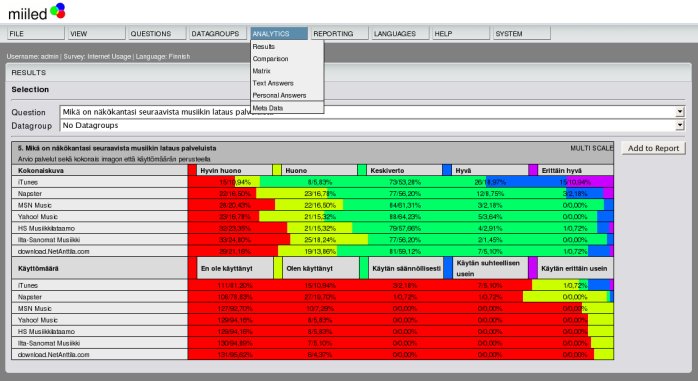
Time flies and soon it is 2008. Our company had signed customers. We had sold and delivered our software both as a product and as a service to number of customers. However the number of customers and the money we were making was abysmal. Our company and our software seemed to have failed in the market. We make the only rational decision that we can and put our company into end-of-life care - continuing delivering service to our paid customers, but not signing or seeking any new ones.
The failure
So what had happened? Why did our startup failed? Well there was large number of different reasons, but in the end the fatal mistake and failure that much contributed to our other failures was the failure of understanding how our customers experienced value.
We as a couple of university students had thought that what customers wanted was a versatile tool with multiple question types and options and various optimized schemes to enhance information gathering from surveys. We thought that the more features and advantaged features we would have the more value customers would experience. We were wrong! We were biased, we were power users, not irregular users of survey tools that most of our potential customers were!
Our potential customers did want a versatile tool, but their experience of value didn't follow our pattern. Instead they got most value from the single function of just having a simple form to gather answers. Of course additional features did add value, but in a diminishing manner. At the end we estimated that at some point more features in our software would actually lower customer experienced value than increase it. This was because more features essentially meant more complex user interface and software, making customers unable to use the tools power.
 |
| Experienced value / number of features |
Lessons learned
There were many lessons learned during our startup. I for one don't regret at all that we started the company. If I hadn't been there and done that, I still would be asking myself on if I could have done it, could I have started a company and what would have come from that. Now I know the answer to that and it brings me great satisfaction that I tried. I failed, but I tried and learned some lessons and that is what is important to me.
And when I look back our company, there were some innovations that came from our customers that were actually very good ideas and our implementations of them worked quite nicely. One could build a successful startup based on one of them, however the business model would be completely different than the one we had. I don't know what the future brings, but maybe I will try entrepreneurship someday, after all it was very fun and exciting time. :-)
Sunday, 11 September 2011
Google+ UI is the future of event driven software
Everybody following up the exciting world of Internet services and Social
media industries has probably heard about Google+, the new social networking
service that Google has created to challenge Facebook, the current leader of
social networking services. In their quest to challenge Facebook, Google has
made tremendous amount of work to invent and innovate new features and new ways
to interact for their service, many of which we in the software industry should
take a note from and learn, one of these things being the user interface.
One particular innovation that I have especially been impressed is Circles.
Circles is a logical innovation to the Facebook innovated event based user
interface. In Facebook the centerpiece of the user interface is the personal
event queue which consists from incoming notifications that have been generated
by our friend and from an outgoing event queue where we push our new
notifications. This is brilliantly simple and allows us easily to connect and
share events with friends. The problem in this arrangement however is that as
the amount of our friends grow, we start to drown to new notifications and
start missing relevant events, we also start to become more hesitant on sharing
new events because we don't want to bother friends with updates to them that
useless and because we want to keep something inside a smaller circle. This is the stepping point for
Circles.
 |
| Facebook - Single queue vs. Google+ - multiple queue |
In Circles you have multiple event queues for different people. You can
have an Circle for friends, family, work colleagues, etc... You can also group
one person to multiple Circles, for example a work colleague can also belong to
friends circle. This way you can easily share updates with the right kind of
people, but also quickly see what different groups of people are doing. This is
of course goes both ways, people belonging to your circles can also freely
decide on which circle you belong. This simple idea makes it easy again to
share and receive events. This is the idea that should be copied to any
software that deals with peoples and events that they generate.
Many different kinds of software and services could benefit from
implementing Google+ Circles type of multiple event queues driven user
interface. For a example CRM software could instead of concentrating to display
information about overall sales or about a customer in hand, the main interface
to the software would be an list of events to which the specific user is tied.
These events could be automatically lifted from email or from calendar or from
phone, they could also be generated from external sources such as customers RSS
feed or picked from web sites or magazines. Events themselves could be grouped
by either customer or customer types. However the key to deliver added value
would be the ability to share events with the internal organizations, allowing
rapid communication and sharing of relevant information in timely manner. One
example of CRM software that has tried to go this way is the Salesforce Chatter, in my opinion Salesforce could have went farther in their
implementation, but it anyway demonstrates many of the strengths of being event centric. Countless other types of software could also be made event
centric, for example why not plug-in version control software and JIRA to
multiple event queues, allowing developers to note changes more quickly, enable
sharing of thoughts and useful resources. In my honest opinion many software
firms would do themselves a favor on investigating if they could transform
their software to be event centric.
Sunday, 21 August 2011
Meego is the strategic choice for mobile vendors
In the past half a year mobile industry has experienced turbulent time of great market changes. When the year started Nokia was still committed to developing Qt-based Symbian and Meego ecosystem, Google backed Android was the preferred choice for the market challengers, and the Apple iPhone was unchallenged industry benchmark. The era of change started when Nokia abandoned its own development efforts and made a deep alliance with Microsoft to adopt Windows Phone as its sole smartphone platform, leaving both Symbian and Meego dead in the water. At the same time Android manufacturers gained momentum while Apple stalled and Nokia lost ground, making it seem that in the near future smartphone market was going to be divided in three camps: Apple iPhone, Google lead Android group, and Microsoft-Nokia. This all changed when Google acquired Motorola Mobility.
While Google informed the public that its acquisition of Motorola Mobility was defensive, that its intention was to obtain patents to defend the Android ecosystem, that it would retain Motorola Mobility as independent subsidiary, that it would treat equally all Android vendors, it is hard to believe that this state of affairs would continue for long. Google made a massive investment and its investors will sooner or later demand results from the management, and from the management the only way to obtain them is to become a vertically integrated company, imitating Apple. Not to mention that in large organizations there is always massive inertia to favor home grown solutions, even if the upper management tries to maintain neutrality with users of Android, the human factor, middle managers and developers inside Google-Motorola will pull and give flavors to each other’s. The simple fact at the end of the day is that due to acquisition of Motorola Mobility, the playground isn't level anymore and by time it will become even less so.
So what is next? Apple doesn't license IOS and with Microsoft the playground isn't even due to Microsoft working closely in deep partnership with Nokia. Fortunately there is a choice that mobile vendors can and should take, that choice is Meego. While Nokia did more or less abandon Meego, Intel continued to push forward and invest into it. It is a production ready mobile OS that is thoroughly modern, easy to develop and adopt. By adopting Meego as one of the used smartphone platforms in their offerings, device manufactures gain by..
..Having leverage against Google and Microsoft. Leverage is needed because both Google and Microsoft have in the past made it clear that they are in charge of their platforms, dictating more or less the terms of usage to manufacturers. They also have taken the freedom of favoring one device manufacturer to further their own goals. To ensure more fair and equal treatment, vendors need to have the nuclear option to threaten abandoning both platforms if needed, this threat should allow manufacturers to gain concessions to modify platforms, but also gain more favorable financial terms to license Android or Windows Phone.
..Allowing deep alliance with network service operators. Since the dawn of mobile networks, service operators have had one single goal, to be something more than just a pipe of bytes. They want their customers to select them not because of their pipes, but because of the unique features and services that they offer as part of their larger customer experience. With Apple, Microsoft and Google the problem is that they offer their own standardized customer experience, leaving operators to be commoditized pipe providers. This creates tremendous opportunities for device manufacturers to ally with service operators to create unique customer experiences, for example operator specific user interfaces that interwove services into tightly packed offering. In case where this co-operation leads to a hit product, benefits are more than clear. It should also again be mentioned that operators to need and want leverage against Google, Apple and Microsoft, which itself makes the business case worthwhile enough.
..Enabling product and brand differentiation via software. The big problem that all major phone manufacturers of today are trying to solve is to how to be different and how to maintain that difference once it is found. Designs can be easily copied or imitated. User interface is the same across the multiple vendors who use the same operating system. Hardware components and technology are the same and used by multiple vendors, buzz words changing from Retina Display and Super AMOLED to Clear Black Display, for the customer it is more or less the same, better than normal displays. The only way to clearly obtain differentiation is via creation of unique software offerings. The only platform that in the future offers this is Meego.
In my honest opinion, there is a very strong case for mobile device manufacturers to make use of Meego. While I don't think that any device manufacturer at this point should commit them solely to it, they should take the option for obvious strategic reasons, as a life insurance, but also as a way to move forward in the ever changing mobile market.
While Google informed the public that its acquisition of Motorola Mobility was defensive, that its intention was to obtain patents to defend the Android ecosystem, that it would retain Motorola Mobility as independent subsidiary, that it would treat equally all Android vendors, it is hard to believe that this state of affairs would continue for long. Google made a massive investment and its investors will sooner or later demand results from the management, and from the management the only way to obtain them is to become a vertically integrated company, imitating Apple. Not to mention that in large organizations there is always massive inertia to favor home grown solutions, even if the upper management tries to maintain neutrality with users of Android, the human factor, middle managers and developers inside Google-Motorola will pull and give flavors to each other’s. The simple fact at the end of the day is that due to acquisition of Motorola Mobility, the playground isn't level anymore and by time it will become even less so.
So what is next? Apple doesn't license IOS and with Microsoft the playground isn't even due to Microsoft working closely in deep partnership with Nokia. Fortunately there is a choice that mobile vendors can and should take, that choice is Meego. While Nokia did more or less abandon Meego, Intel continued to push forward and invest into it. It is a production ready mobile OS that is thoroughly modern, easy to develop and adopt. By adopting Meego as one of the used smartphone platforms in their offerings, device manufactures gain by..
..Having leverage against Google and Microsoft. Leverage is needed because both Google and Microsoft have in the past made it clear that they are in charge of their platforms, dictating more or less the terms of usage to manufacturers. They also have taken the freedom of favoring one device manufacturer to further their own goals. To ensure more fair and equal treatment, vendors need to have the nuclear option to threaten abandoning both platforms if needed, this threat should allow manufacturers to gain concessions to modify platforms, but also gain more favorable financial terms to license Android or Windows Phone.
..Allowing deep alliance with network service operators. Since the dawn of mobile networks, service operators have had one single goal, to be something more than just a pipe of bytes. They want their customers to select them not because of their pipes, but because of the unique features and services that they offer as part of their larger customer experience. With Apple, Microsoft and Google the problem is that they offer their own standardized customer experience, leaving operators to be commoditized pipe providers. This creates tremendous opportunities for device manufacturers to ally with service operators to create unique customer experiences, for example operator specific user interfaces that interwove services into tightly packed offering. In case where this co-operation leads to a hit product, benefits are more than clear. It should also again be mentioned that operators to need and want leverage against Google, Apple and Microsoft, which itself makes the business case worthwhile enough.
..Enabling product and brand differentiation via software. The big problem that all major phone manufacturers of today are trying to solve is to how to be different and how to maintain that difference once it is found. Designs can be easily copied or imitated. User interface is the same across the multiple vendors who use the same operating system. Hardware components and technology are the same and used by multiple vendors, buzz words changing from Retina Display and Super AMOLED to Clear Black Display, for the customer it is more or less the same, better than normal displays. The only way to clearly obtain differentiation is via creation of unique software offerings. The only platform that in the future offers this is Meego.
In my honest opinion, there is a very strong case for mobile device manufacturers to make use of Meego. While I don't think that any device manufacturer at this point should commit them solely to it, they should take the option for obvious strategic reasons, as a life insurance, but also as a way to move forward in the ever changing mobile market.
Subscribe to:
Posts (Atom)